How to Calculate Binomial Distribution: A Step-by-Step Guide

TL;DR
Master the binomial distribution formula with this complete guide. Learn how to calculate binomial probability, understand the conditions for a binomial experiment, and use our free online calculator.
Table of Contents
Probability plays a massive role in statistics, and one of the most important concepts to master is the Binomial Distribution. Whether you are predicting the outcome of a coin toss, analyzing quality control in manufacturing, or studying for a statistics exam, understanding how to calculate binomial distribution is essential.
In this guide, we will break down the binomial experiment formula, explain the key conditions for a binomial trial, and show you how to solve problems step-by-step. Plus, we'll introduce you to our Binomial Distribution Calculator that makes the process instant.
What is Binomial Distribution?
The binomial probability distribution describes the probability of obtaining a specific number of "successes" in a fixed number of independent trials. It is applicable only when there are exactly two mutually exclusive outcomes for each trial: Success or Failure.
Key Conditions for a Binomial Experiment
- Fixed Number of Trials (n): The experiment is repeated a specific number of times.
- Two Outcomes: Each trial results in either "Success" or "Failure".
- Independent Trials: The outcome of one trial does not affect the others.
- Constant Probability (p): The probability of success remains the same for every trial.
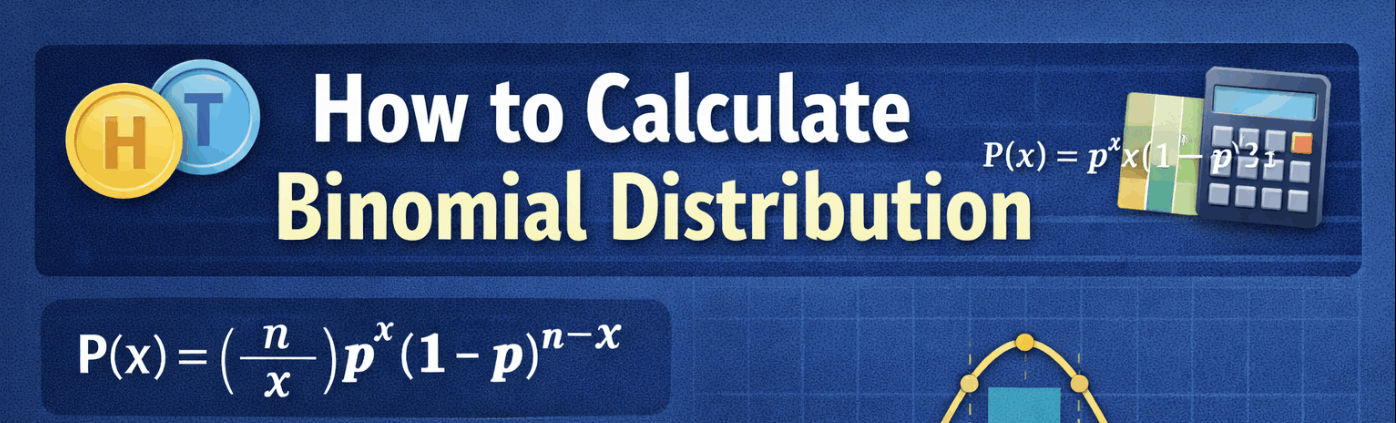
The Binomial Distribution Formula
To manually find the probability, you use the binomial distribution formula calculator logic:
P(X = x) = nCx · px · (1-p)n-x
Where:
- nTotal number of trials
- xNumber of successes desired
- pProbability of success in one trial
- qProbability of failure (1 - p)
How to Calculate Binomial Probability: An Example
Let's say you flip a fair coin 5 times (n=5). You want to know the probability of getting exactly 3 heads (x=3). Since it's a fair coin, the probability of heads is 0.5 (p=0.5).
Step 1: Calculate the Combination (nCx)
First, calculate how many ways you can choose 3 successes out of 5 trials.5C3 = 5! / (3! * (5-3)!) = 10
Step 2: Calculate px and (1-p)n-x
0.5^3 = 0.125(1-0.5)^(5-3) = 0.5^2 = 0.25
Step 3: Multiply it all together
P(X=3) = 10 * 0.125 * 0.25 = 0.3125
So, there is a 31.25% chance of getting exactly 3 heads.
Understanding the Binomial Curve
When you plot the probabilities for all possible values of x (from 0 to n), you get the binomial curve.
- If p = 0.5, the distribution is symmetric (bell-shaped).
- If p < 0.5, the distribution is skewed to the right.
- If p > 0.5, the distribution is skewed to the left.
Visualizing this helps in understanding the likelihood of different outcomes. Our binomial probability distribution calculator automatically generates this graph for you.
How to Do Binomial Distribution on Calculator (TI-84)
Many students ask about the binomial distribution calculator TI 84 method. Here is a quick guide:
- Press [2nd] then [VARS] (to access the DISTR menu).
- Scroll down to select A: binompdf( for exact probability or B: binomcdf( for cumulative probability.
- Enter the parameters:
trials, p, x value. - Press [ENTER] to see the result.
The Easier Way: Use Our Free Tool
Why struggle with manual formulas or complex calculator menus? Our online tool is designed to be the best binomial distribution probability calculator available.
Try the Binomial Distribution Calculator
Get instant results for exact, less than, or greater than probabilities, complete with a visual graph.
Launch CalculatorFrequently Asked Questions
How do you calculate binomial distribution mean and variance?
The mean is simply μ = n * p. The variance is σ² = n * p * (1 - p).
What is the difference between binompdf and binomcdf?
binompdf calculates the probability of an exact value (e.g., exactly 3 heads). binomcdf calculates the cumulative probability (e.g., 3 heads or fewer).
For more details, check out our Binomial Distribution Calculator.

Was this article helpful?
Comments
Loading comments...